
Course purpose
Aviation organizations operate inside a highly interdependent system. A single management decision can affect safety, customer service, employee workload, regulatory compliance, reputation, and financial performance. For that reason, this course treats management as an applied discipline rather than a collection of disconnected theories. Students are expected to connect concepts to the daily realities of flight operations, airports, training units, maintenance providers, dispatch offices, and executive teams.
A textbook-level understanding requires more than memorizing terms. Students must learn to diagnose a situation, identify the stakeholders involved, recognize the limits of available evidence, and choose a practical response. The chapters therefore include frameworks, examples, tables, decision tools, reflective questions, and short case applications. These learning features are designed to help students move from knowing concepts to using them in realistic aviation environments.
The aviation sector rewards disciplined thinking. Managers often face pressure to move quickly, reduce cost, satisfy customers, or recover from disruption. Sound management does not ignore those pressures; it organizes them. The goal is to make responsible decisions that protect the public, support employees, and sustain the organization over time. This course repeatedly returns to that balance between operational discipline and strategic judgment.
Course Map and 120-Hour Learning Structure
This course is organized into twelve modules. Each module represents approximately ten hours of learning through reading, guided notes, examples, discussion preparation, applied activities, and independent study. The structure is intentionally textbook-like so that students can learn concepts and also see how those concepts are used in aviation management practice.
| Module | Topic | Learning hours | Core output | Assessment connection |
| 1 | Executive Role in Aviation Organizations | 10 | Notes, discussion response, applied tool | MCQ/capstone readiness |
| 2 | Safety Culture and Just Culture | 10 | Notes, discussion response, applied tool | MCQ/capstone readiness |
| 3 | Crew Resource Management for Leaders | 10 | Notes, discussion response, applied tool | MCQ/capstone readiness |
| 4 | Leading Operational Teams | 10 | Notes, discussion response, applied tool | MCQ/capstone readiness |
| 5 | Decision Making Under Pressure | 10 | Notes, discussion response, applied tool | MCQ/capstone readiness |
| 6 | Organizational Communication | 10 | Notes, discussion response, applied tool | MCQ/capstone readiness |
| 7 | Change Management and Innovation | 10 | Notes, discussion response, applied tool | MCQ/capstone readiness |
| 8 | Ethics, Accountability, and Professional Judgment | 10 | Notes, discussion response, applied tool | MCQ/capstone readiness |
| 9 | Human Factors and Fatigue Leadership | 10 | Notes, discussion response, applied tool | MCQ/capstone readiness |
| 10 | Crisis Leadership and Resilience | 10 | Notes, discussion response, applied tool | MCQ/capstone readiness |
| 11 | Talent, Coaching, and Succession | 10 | Notes, discussion response, applied tool | MCQ/capstone readiness |
| 12 | Strategic Leadership Project | 10 | Notes, discussion response, applied tool | MCQ/capstone readiness |
Suggested pacing: complete one module per week in a twelve-week term, or two modules per week in an intensive six-week format. Instructors may also use the course as a reference package for lectures, seminars, and workplace-based projects.
Visual Frameworks Used in This Course
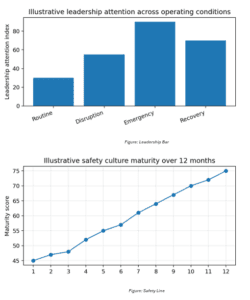
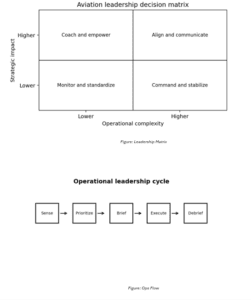
The following diagrams and charts are illustrative teaching tools. They are not presented as industry-wide statistical findings. Their purpose is to help students interpret patterns, compare alternatives, and discuss management decisions with a visual frame of reference.