

Preface
Aviation risk management is a practical management discipline used across flight training units, airlines, airports, maintenance organizations, ground handling operations, aviation administration, and other safety-sensitive environments. Safe performance is not produced by slogans or paperwork alone. It emerges when leaders define clear expectations, people report hazards, teams assess exposure, controls are implemented, evidence is reviewed, and the organization learns before weak signals become serious events.
This edition is written as a student-facing textbook. It explains risk management through aviation operations, management decisions, practical tools, case-based thinking and evidence. The aim is not to memorize safety vocabulary; it is to use the vocabulary accurately while observing work, judging control strength and communicating defensible action.
Learning Outcomes
- Explain hazards, risks, consequences, controls, residual risk, and tolerability using disciplined aviation language.
- Apply risk matrices, risk registers, bow-tie analysis, barrier thinking, and management-of-change methods.
- Evaluate the four components of a Safety Management System and the responsibilities of leaders and employees.
- Interpret human factors, fatigue, communication, workload, culture, and organizational pressure as risk influences.
- Design safety assurance tools such as indicators, dashboards, audits, inspections, CAPA logs, and management reviews.
- Plan emergency response, conduct structured investigations, and translate findings into verified organizational learning.
Contents
Unit 1 – Foundations of Aviation Safety and Risk Thinking
- Chapter 1: Safety Concepts and the Evolution of Risk Thinking
- Chapter 2: Hazard Identification and Risk Assessment
- Chapter 3: Human Factors, Culture and Accountability
- Unit 1 Applied Assignment
Unit 2 – Safety Management Systems and Organizational Safety Culture
- Chapter 4: Policy, Objectives and Governance
- Chapter 5: Reporting, Just Culture and Safety Risk Management
- Chapter 6: Assurance, Promotion and Management of Change
- Unit 2 Applied Assignment
Unit 3 – Operational Controls, Assurance and Emergency Preparedness
- Chapter 7: Barrier Management and Operational Controls
- Chapter 8: Audits, Indicators, Dashboards and CAPA
- Chapter 9: Emergency Response and Evidence Management
- Unit 3 Applied Assignment
Unit 4 – Investigation, Learning, Resilience and Integrated Safety Leadership
- Chapter 10: Occurrence Triage and Investigation
- Chapter 11: Learning, Resilience, Ethics and Transparency
- Chapter 12: Integrated Safety Leadership and Future Risks
- Unit 4 Applied Assignment
Applied Aviation Management Toolkit
Capstone Project Guide
Final Knowledge Check
Glossary of Aviation Safety Terms
References and Further Reading
Introduction
Aviation risk management is a practical management discipline used across flight training units, airlines, airports, maintenance organizations, ground handling operations, aviation administration, and other safety-sensitive environments. Safe performance is not produced by slogans or paperwork alone. It emerges when leaders define clear expectations, people report hazards, teams assess exposure, controls are implemented, evidence is reviewed, and the organization learns before weak signals become serious events.
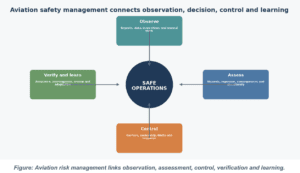
Figure: Aviation risk management links observation, assessment, control, verification and learning.
| How to read the visuals Every diagram is a decision aid. Read the labels, identify assumptions, compare the model with real aviation work and ask what evidence would show that a control is functioning. |